Showing posts with label holy week. Show all posts

Thursday, April 21, 2011

What to Pray For

Christ tells us to stay awake, but not for cards and dice, not for rowdy parties and drunken brawls, not for wine and women, but for prayer. He tells us to pray not occasionally, but constantly. "Pray," He says, "unceasingly." He tells us to pray not only during the day (for it is hardly necessary to command anyone to stay awake during the day) but rather He exhorts us to devote to intense prayer a large part of that very time which most of usually devote entirely to sleep. How much more, then, should we be ashamed of our miserable performance and recognize the enormous guilt we incur by saying no more than a short prayer or two, perhaps, during the day, and even those said as we doze and yawn.

Finally, our Savior tells us to pray, not that we may roll in wealth, not that we may live in a continuous round of pleasures, not that something awful may happen to our enemies, not that we may receive honor in this world, but rather that we may not enter into temptation. In fact, He wishes us to understand that all those worldly goods are either downright harmful, or else, by comparison with that one benefit, the merest trifles; and hence in His wisdom He placed this one petition at the end of the prayer which He had previously taught His disciples, as if it were a summary in a way, of all the rest: "And lead us not into temptation, but deliver us from evil."
St. Thomas More, The Sadness of Christ

Tuesday, April 19, 2011

Easter Bonnets, Attitudes, and Yawning

 Image credit: Topic Topos

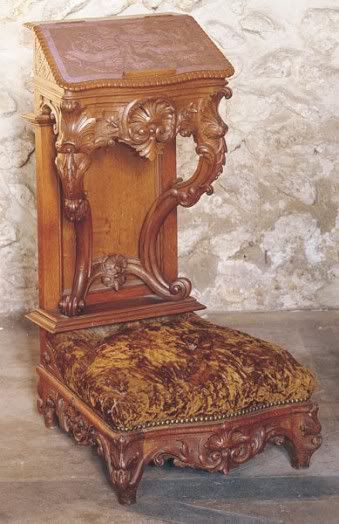
Just as our minds are inattentive when we set out to pray, so too we proceed to do so with an equally careless and sprawling deportment of our bodies. True, we pretend that the worship of God is our reason for wearing better than everyday clothes on feast days, but the negligence with which most of us pray makes it utterly clear that we have utterly failed to conceal the real motive, namely a haughty desire to show off in the eyes of the world. Thus in our negligence we sometimes stroll around, sometimes sit down on a stool. And even when we kneel down, we either place our weight on one knee, raising up the other and resting it on our foot, or we place a cushion under our knees, and sometimes (if we are especially spoiled) we even support our elbows on a cushion, looking for all the world like a propped up house that is threatening to tumble down.

And then our actions too, in how many ways do they betray that our minds are wandering miles away? We scratch our heads, clean our fingernails with a pocketknife, pick our noses with our fingers, meanwhile making the wrong responses. Having no idea what we have already said and what we have not said, we make a wild guess as to what remains to be said. Are we not ashamed to pray in such a deranged state of mind and body -- to beseech God's favor in a matter so crucial for us, to beg His forgiveness for so many monstrous misdeeds, to ask Him to save us from eternal punishment? -- so that even if we had not sinned before, we would still deserve tenfold eternal torments for having approached the majesty of God in such a contemptuous fashion.

Imagine, if you will, that you have committed a crime of high treason against some mortal prince or other who has your life in his hands but who is so merciful that he is prepared to temper his wrath because of your repentance and humble supplication, and to commute the death sentence into a monetary fine or even to suspend it completely if you give convincing signs of great shame and sorrow. Now, when you have been brought into the presence of the prince, go ahead and speak to him carelessly, casually, without the least concern. While he stays in one place and listens attentively, stroll around here and there as you run through your plea. Then, when you have had enough of walking up and down, sit down on a chair, or if courtesy seems to require that you condescend to kneel down, first command someone to come and place a cushion beneath your knees, or, better yet, to bring a prie-dieu with another cushion to lean your elbows on. Then yawn, stretch, sneeze, spit without giving it a thought, and belch up the fumes of your gluttony. In short, conduct yourself in such a way that he can clearly see from your face, your voice, your gestures, and your whole bodily deportment that while you are addressing him you are thinking about something else. Tellm e now, what success could you hope for from such a plea as this?

Certainly we would consider it quite mad to defend ourselves in this way before a mortal prince against a charge that carries the death penalty. And yet such a prince, once he had destroyed our bodies, could do nothing further. And do we think it is reasonable, when we have been caught committing a whole series of far more serious crimes, to beg pardon so contemptuously from the king of all kings, God Himself, who, when He has destroyed our bodies, has the power to send both body and soul together to hell?

Still, I would not wish anyone to construe what I have said as meaning that I forbid anyone to pray while walking or sitting or even lying down. Indeed I wish that, whatever our bodies may be doing, we would at the same time constantly lift up our minds to God (which is the most acceptable form of prayer). For no matter where we may turn our steps, as long as our minds are directed to God, we clearly do not turn away from Him who is present everywhere.... but... besides such prayers for which we prepare our minds more thoughtfully, for which we dispose our bodies more reverently, than we would if we were about to approach all the kings in the whole world sitting together in one place.
St. Thomas More, The Sadness of Christ

Monday, April 18, 2011

An Instant Remedy for Sleeping While Praying

Every year during Holy Week, I read St. Thomas More's The Sadness of Christ (published in a volume of his Selected Writings). It is one of the most beautiful, profound, and yet (if I may say so) witty meditations I have ever encountered.

During the 14 months he was locked in the Tower of London awaiting his own trial and execution, St. Thomas More wrote this 116 page meditation on Christ's Agony in the Garden. The work carefully parses every phrase of the Gospels relating the Agony in the Garden, and offers pointed applications to daily life.

In this holiest of weeks, I will be sharing with you some excerpts from his work, and highly encourage you to get a copy for yourself so as to enter more deeply in pray into the mystery of Christ's Passion.
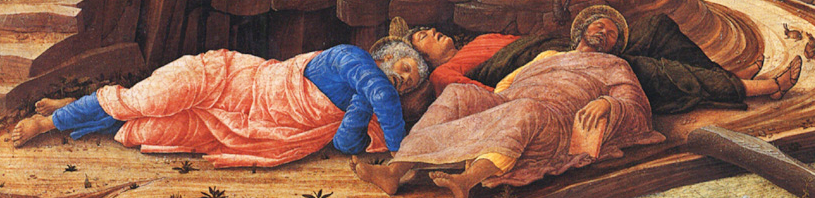
Image: Agony in the Garden, Andrea Montegna

"Get up and pray that you may not enter into temptation." (Luke 22:46)

Before, He ordered them to watch and pray. Now that they have twice learned by experience that the drowsy position of sitting lets sleep gradually slip on them, He teaches an instant remedy for that sluggish disease of somnolence, namely to get up. Since this sort of remedy was handed down by our Savior Himself, I heartily wish that we would occasionally be willing to try it out at the dead of night. For here we would discover not only that well begun is half done (as Horace says), but that once begun is all done.

For when we are fighting against sleep, the first encounter is always the sharpest. Therefore, we should not try to conquer sleep by a prolonged struggle, but rather we should break with one thrust the grip of the alluring arms with which it embraces us and pulls us down, and we should dash away from it all of a sudden... Then, if we devote ourselves to meditation and prayer, the mind, collected and composed in that dark silence of the night, will find that it is much more receptive to divine consolation than it is during the daytime, when the noisy bustle of business on all sides distracts the eyes, the ears, and the mind, and dissipates our energy in manifold activities, no less pointless than they are divers.

But Lord spare us, though thoughts about some trifling matter, some worldly matter at that, may sometimes interrupt our sleep and keep us awake for a long time and hardly let us go back to sleep at all, prayer does not keep us awake: in spite of the immense loss of spiritual benefits, in spite of the many traps set for us by our deadly enemy, in spite of the danger of being utterly undone, we do not wake up to pray, but lie in a drugged sleep watching the dream-visions induced by mandragora.

But we must continually keep in mind that Christ did not command them simply to get up, but to get up in order to pray...
St. Thomas More, The Sadness of Christ