Showing posts with label farm life. Show all posts

Thursday, January 24, 2013

How to Can Dry Chickpeas, Kidney Beans, Pintos, Black Beans

I've read a lot lately about the health benefits of eating beans. Lowers cholesterol, helps maintain blood sugar, good for digestion, lots of nutrients, cheap (though incomplete) source of protein, etc.

My pantry has been stocked with dry beans forever. Every week I put them on our menu plan, and most weeks I take an alternate route because, "they take forever to cook!" Soaking the night before, a low-slow cook for most of the day, and then, worst of all, there are tons of leftovers. Why go through all the hassle just to make a small batch for the two of us? So I always make tons, intending to eat frugally on them all week.

I like beans well enough, but I've had to admit, I don't like leftover beans. There's only so much chili I can make them into, and there are only so many little containers of leftover beans I can stick in the back of the freezer for that afternoon when I tell myself, "I know! I want to eat beans today!"

The crisis point came a few weeks ago when we discovered evidence of mice in our pantry. My bag of dried split peas had bite marks all over it, so I was forced to toss the lot. I scrutinized the rest of the sacks of various dried beans but they appeared untouched, for now. "If I don't store these better, I'm going to lose them." I don't like throwing away food.

My canner called out to me.

Hm... a can of beans around here is 70-90 cents. A few pounds of dried beans (which makes seven pints) costs about the same.

And canned beans are always ready to eat... no soaking, no long cooking times, and no leftovers.

Compared to tomatoes and homemade jams, canning dried beans is really easy.

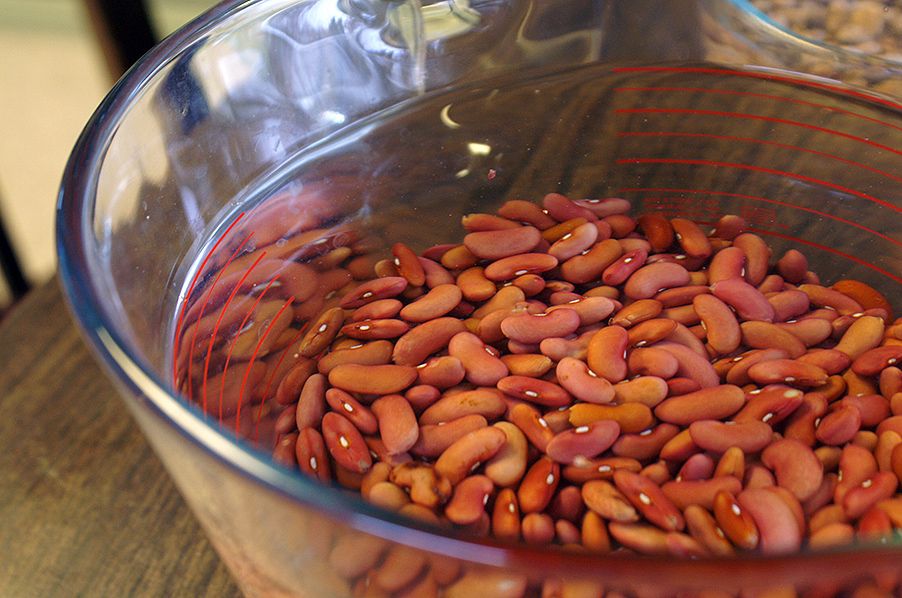
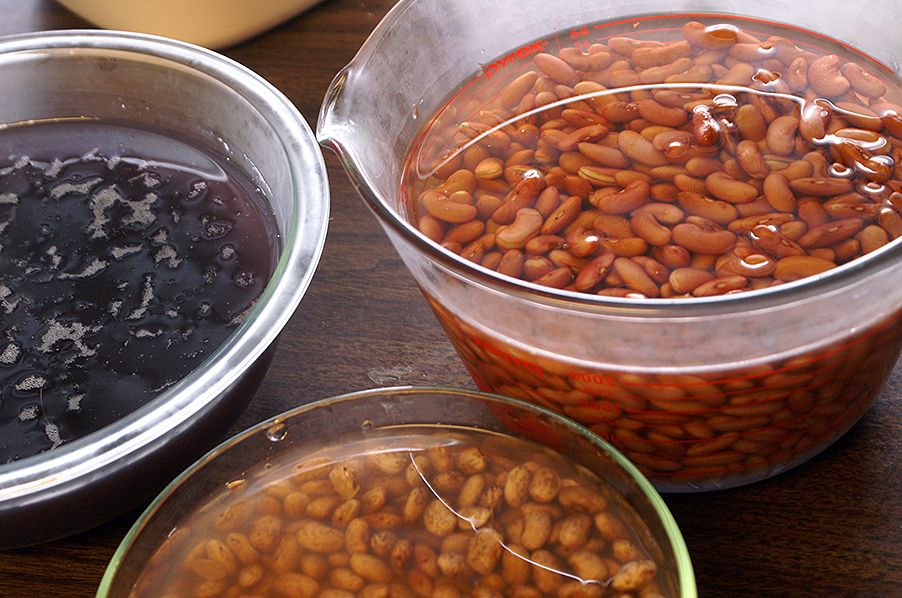
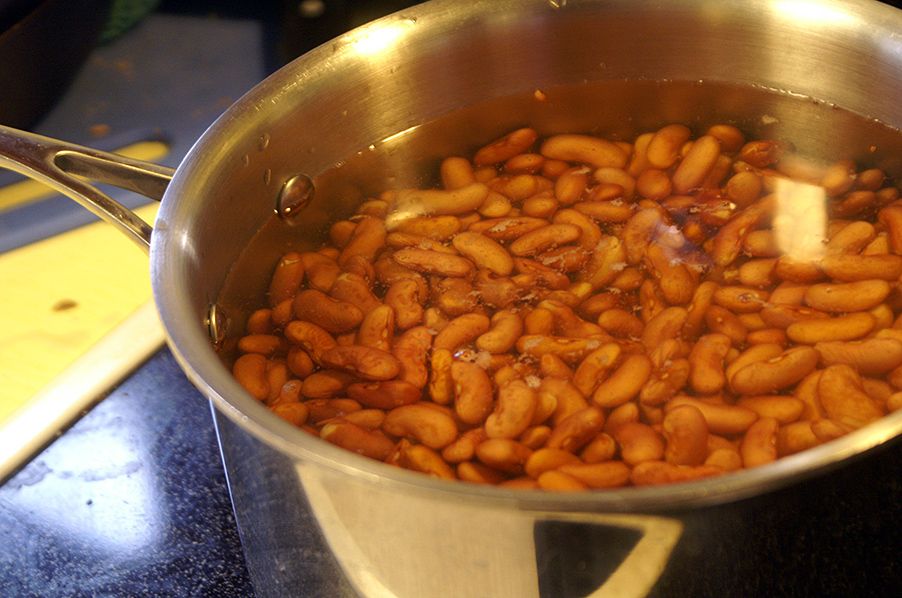
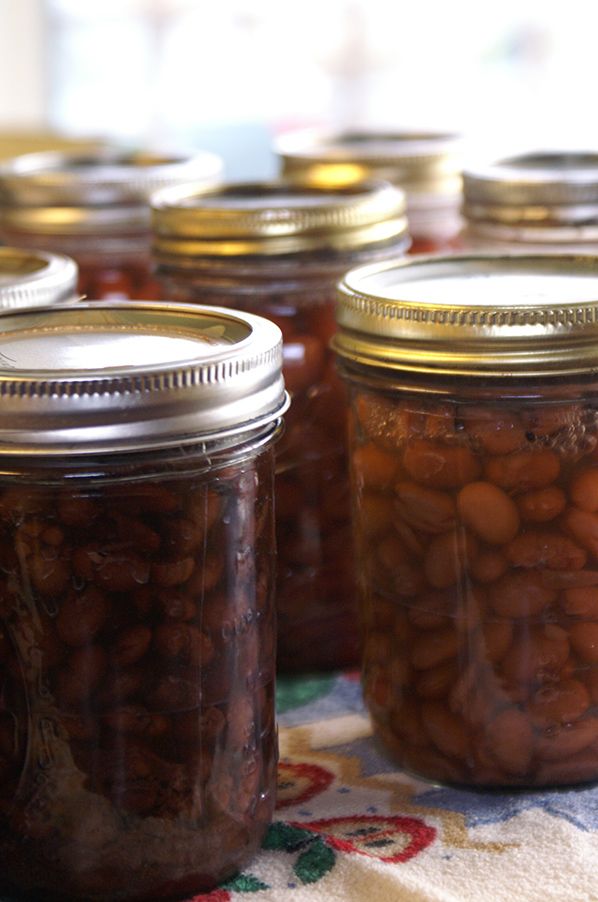
 Soak the beans in water (here I have black beans, pintos, and kidneys... I did chickpeas the next day).

I think they're really pretty.

By the next morning they've about doubled in volume.

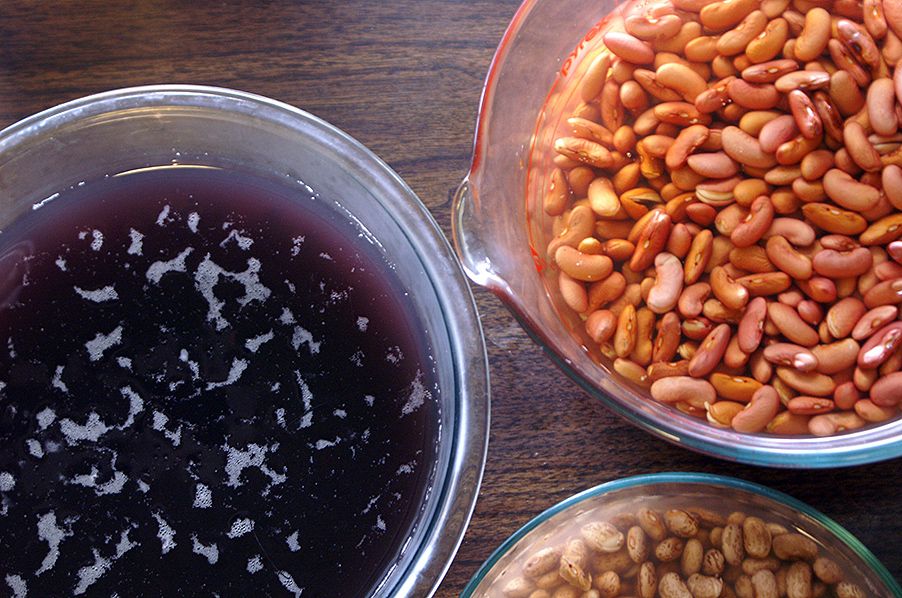
 It amazes me that the black bean water turns purple.

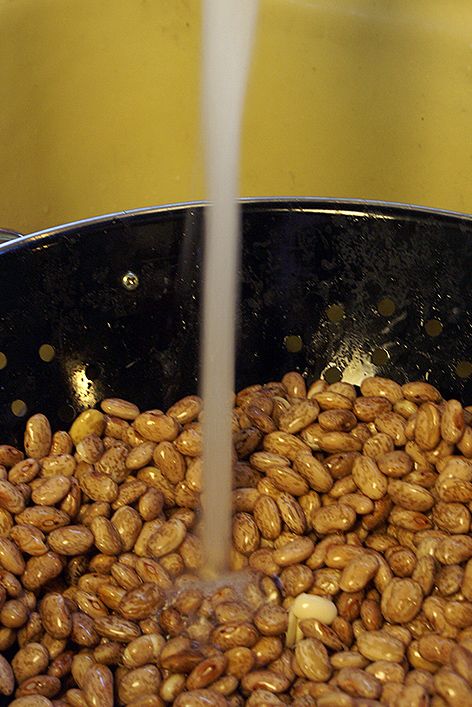
Drain and rinse the beans well. Purportedly, this helps alleviate the... uncomfortable and indelicate symptoms that many people have when they eat beans.

Cover with water and boil for 30 minutes.

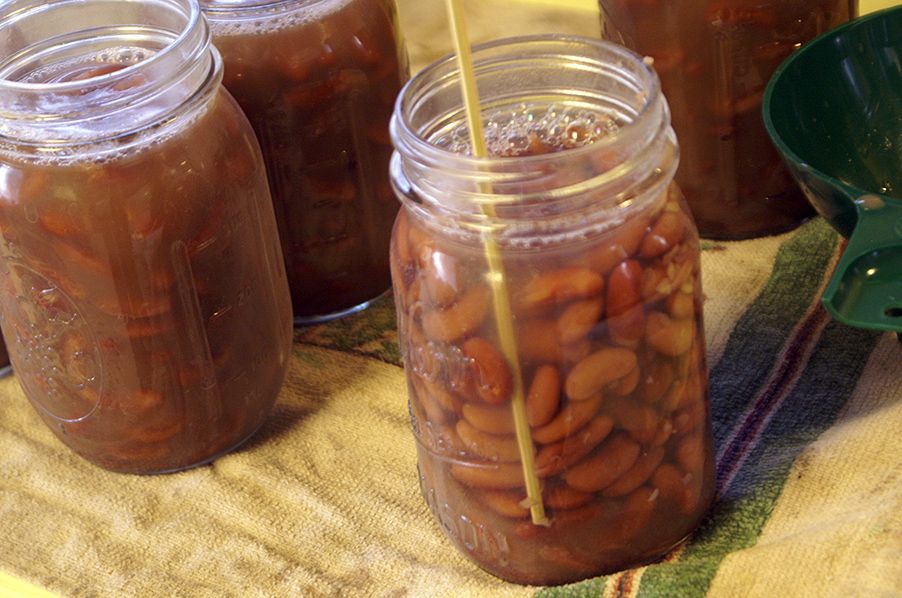
Put the beans in a jar, cover with water (cooking water or boiling water) leave 1" headspace, use a non-metal utensil (I used a wooden kebab skewer) to release air bubbles, wipe the rim, cap with sterilized lid, finger-tighten the ring.

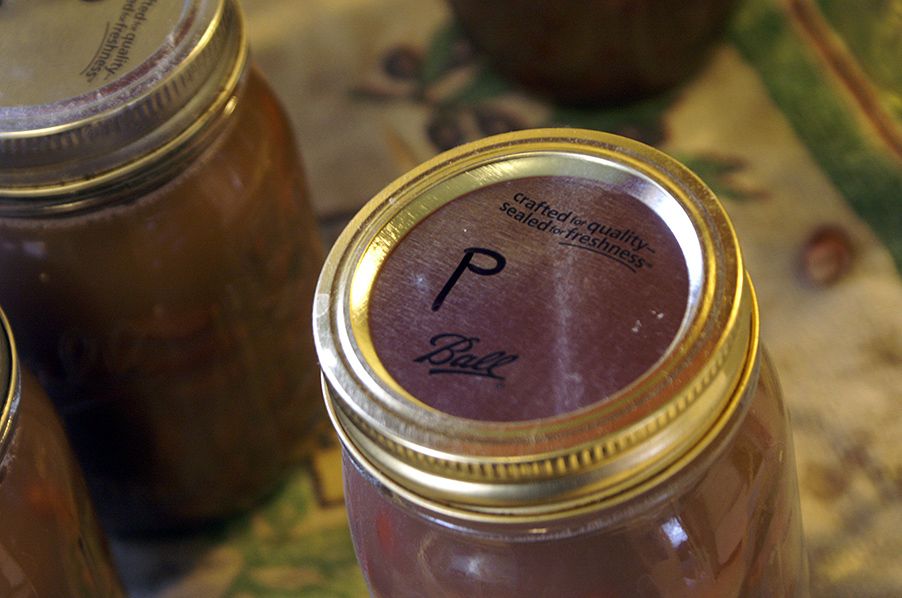
Because I was canning three kinds of beans in one batch, I labeled each jar lid with a Sharpie before processing to keep them straight... P for Pinto beans.

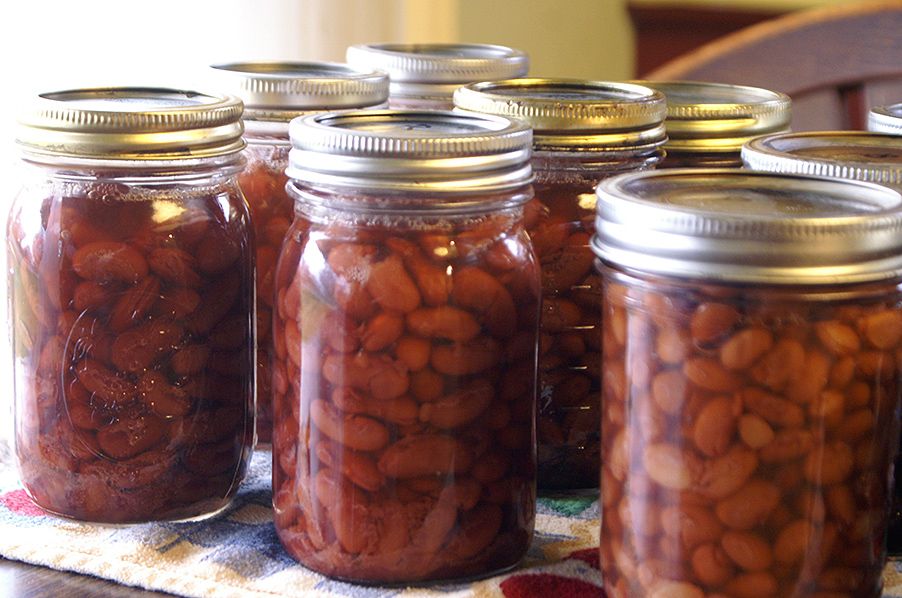
Process in a pressure canner 75 minutes for pints or 90 minutes for quarts. Don't open the lid of the canner until the pressure is completely down and the canner is cool to the touch (removing the lid while the canner is still warm can lead to water reduction in the jars -- if they seal they're still safe to store, but they're not as pretty).

Truly that's it.

Refried beans, red beans and rice, black bean corn salad, burritos, black bean burgers, enchiladas, chili, falafel, roasted chickpeas, hummus... suddenly my meal plan doesn't look as impossible.

How To Can Dry Beans
(like chickpeas, kidney beans, black beans, red beans, navy beans, etc.)

1. Soak beans in water (at least 2 parts water, 1 part beans) for 8-12 hours (overnight).

2. Drain and rinse beans well, put in a pot, cover with water, and boil for 30 minutes.

3. Put hot beans in warm sterilized jars, cover the beans with water (the cooking liquid or simply boiling water) and leave 1" of headspace. Run a non-metal instrument around the inside to release air bubbles, wipe the rim with a clean cloth, place a sterilized lid and finger-tighten the band.

4. Process in a pressure canner (I have always hated the direction, "process in a pressure canner," because it is so vague and non-helpful. But truly, I won't be more specific than that, because you should read your canner's manual to see how to operate it... they're all slightly different.) as follows:

For Dial Gauge Pressure Canner: 
Pints: Process 75 minutes
Quarts: Process 90 Minutes

If your altitude is: 
0-2000’ - process at 11 lbs. pressure
2000-4000’ – process at 12 lbs. pressure
4000-6000’ – Process at 13 lbs. pressure
6000-8000’ – Process at 14 lbs. pressure

Weighted Gauge Pressure Canner: 
Pints: Process 75 minutes
Quarts: Process 90 Minutes

If your altitude is: 
0-1000’ – Process at 10 lbs. pressure
Above 1000’ – Process at 15 lbs. pressure

Tuesday, January 17, 2012

Downsized Dreams

It's cold, raining, and threatening to snow. I'm outside with loppers, frozen hands, smarting cheeks and a runny nose doing manual labor.

Rewind a week.

I was inside, snuggly warm, sipping hot tea, gushing over the hundreds of fruit tree varieties in a new, crisp, brightly colored mail-order garden catalog.

"Five apple trees, 4 pears, 2 peaches, 2 nectarines, 2 plums, 2 apricots..." I merrily hummed the order as I highlighted each appetizing selection. "Hm.. I need kiwis, honeyberries, sea berries, cranberries, elderberries, gooseberries, quince... a variety of nut trees... a few dozen each of raspberry, blackberry and bluberry bushes..."

It didn't take long before I'd highlighted myself into an $890 corner (before taxes, shipping and handling).

Burn.

I furiously schemed how I could raise the money for my fantasy farm in time to place an order, at least for next year. It took a little finagling of the budget, but I know I can do it.

Fast forward to the frozen scene.

What am I doing? Helping my husband prune a tree. A semi-dwarf fruit tree. One. Uno. A single tree. And it's hard work. And it's cold. Did I mention my frozen fingers?

"You mean I'd have to do this on 32 trees? Every year?"

Who wants honeyberries anyway?

Wednesday, November 23, 2011

Peeling Chicken Feet: The Grossest Experience of 2011

According to Julia Child, French chefs, and traditional foodies, the absolute best chicken stock that can be made includes chicken feet. It, supposedly, adds a depth of flavor and a huge amount of gelatin (for superior stocks) that footless stocks just can't match.

You can't exactly waltz down to the grocery store and come back with chicken feet, though.

So I'll admit it... the awful truth... ever since I saw Julia Child make her stock with chicken feet I've been waiting for one of my laying hens to die.

Rather than one of the cannibal biddies, though, unfortunately the first one to bite the dust was Howard. You may remember our Polish Crested rooster from this post. He was a cocky little crower, but he crowed his last earlier this week when he was run over by the moving coop. RIP Howard.

My husband did the thankless task of plucking and gutting, and brought Howard home for me to stew... feet included.

Let me tell you... nothing I read about the delights of French cooking prepared me for the NIGHTMARISH experience of actually skinning chicken feet!!!

The how-to is easy enough. You boil the feet for about 1 or 2 minutes and then plunge them into cold water. Supposedly the skin slips off just like on a tomato. BUT THEY FAILED TO MENTION THAT IT GETS CAUGHT ON THE TOENAILS! EEEEEEWW!!!!!

I called my father for moral support. I was so grateful that he didn't laugh at me when I told him I was skinning chicken feet. He held my hand over the phone and without him I don't think I could have done it.

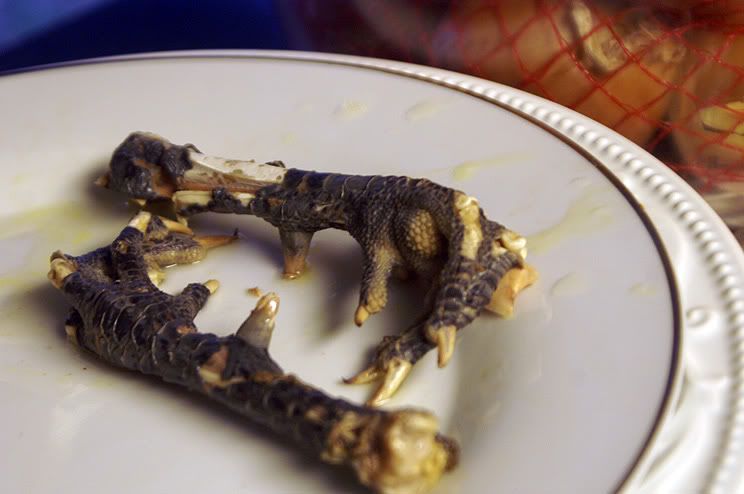
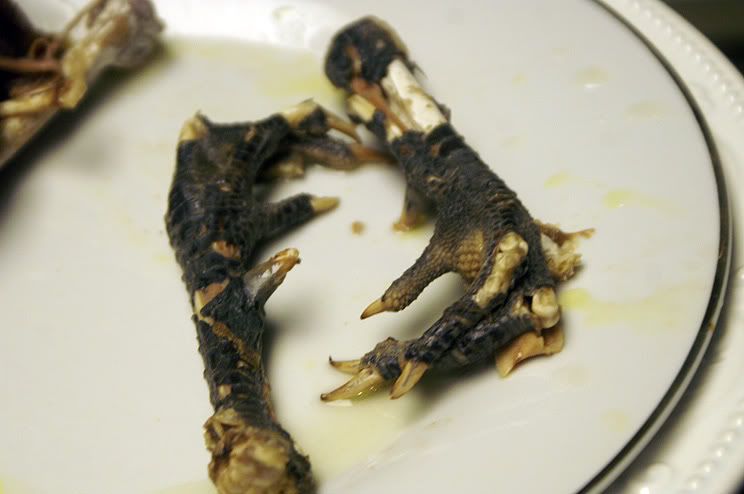
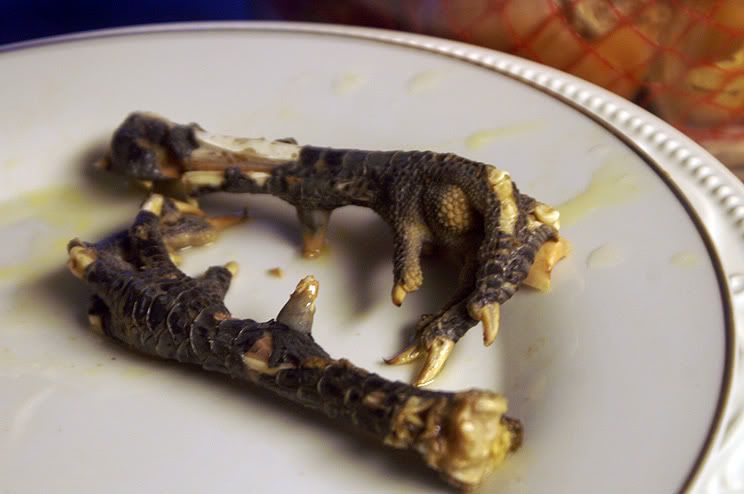
Think I'm exaggerating the grossness? Feast your eyes on this:


Those, dear ladies, are Howard's skinned feet (stewed for 24 hours).


I don't think any soup on earth could be worth the horror of peeling a chicken foot and having the claw come back to clench your finger as you drop its snake-like shedded skin.


This soup had darned better be worth it.

Farm life initiation lesson 436: complete.

Friday, October 28, 2011

Ofelia's Fate Revealed

Well....

......
........
..........
............

No real surprise, actually. Poor Ofelia isn't pregnant.


HOWEVER, I really can't bear to eat my first milk cow. No, we never got a drop of milk out of her, but she was awfully cute, she gave me hope for being a milk maid, and she was a mascot of sorts for the farm.

So we cancelled her date with the butcher and are sending an infertile beef heifer in her place. No, Ofelia's not going to retire and live out the end of her days with us. We are going to sell her at the cow sale, where, most likely, she will ultimately meet her maker... but she won't be buried in our freezer.

Who knows? Maybe somebody will buy her as a dairy cow and give her another go! Good luck, Ofelia.

Wednesday, October 26, 2011

Date With Fate

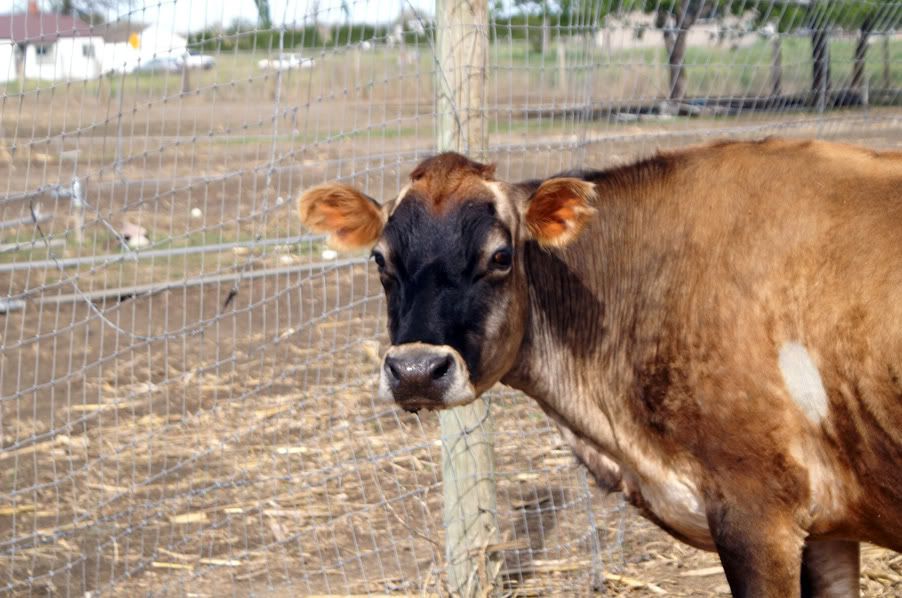
Poor Ofelia, our dry milk cow.

She is going to be preg tested this Friday.

The results of her test will determine whether I clean out my freezer or call to cancel her butcher appointment on November 29th.

She's such a cute cow, and she has a lot of personality. It will be dreadfully sad, but a milk cow who can't have calves (and thus produce milk) is a useless eater on a farm.

Sometimes farmy life isn't much fun.

Wednesday, August 24, 2011

A Farm Life Vignette

Somebody, large, fat, and snoopy couldn't handle her Atkins diet anymore.


She's been surreptitiously watching my husband open the coop door each day, as he gives the chubby biddies their ample ration of grain.

There have been loud complaints from the ungrateful ungulate about the fact that she only has pasture and hay, when what she really needs to maintain her sleek physique are some hearty whole grains.

As she's failed to produce a single drop of milk, which is her sole purpose in life, her complaints have largely fallen upon deaf ears.

So she took matters into her own... hooves.

At an undisclosed hour, the roguish ruminant unlatched the coop door, and squished her fat belly through the frame, ignoring the terrified tremors and flying feathers of the petrified poultry, focused fully on getting her carb fix. She indulged. She glutted.

But she was caught, bread handed, by the farmer.

A strong line of electric fencing has now been attached to the coop. She'll be in for a shock next time she heads for the bread box.

Thursday, June 23, 2011

4 Things We Learned About Raising Chicks

Well, our new little chicks are almost three weeks old now.

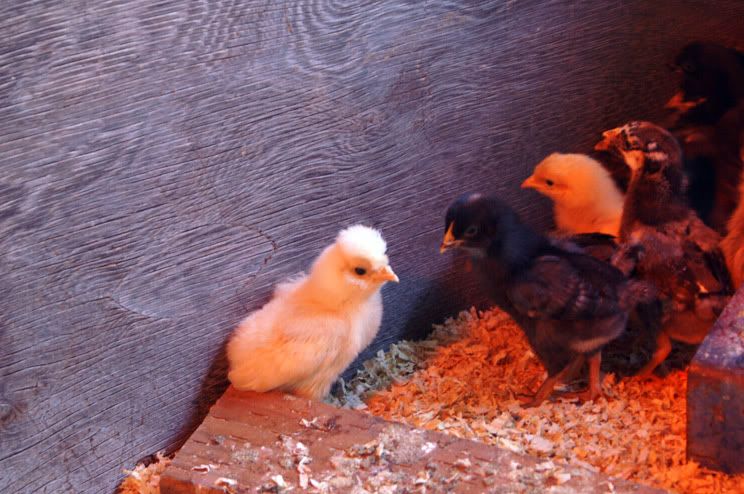
So far there has been no cannibalization (picking on each other and eating feathers) in this crowd, as was rampant in the last bunch. They're just fat and happy little birds.

We learned quite a bit from our first experience of raising chickens last Summer. These are just a few items I wish I'd known (despite copious amounts of research) last year:

#1: You absolutely need plenty of space in the brooder. Crowded chicks aren't happy. Those little cardboard-rolls that you see in every "chick starter kit" are useless after the first week. Start out with a great big area (ours is a 4x4 wooden apple bin).

#2: Don't be paranoid about the brooding temperature. I drove myself batty last year trying to keep the brooder at exactly 95 degrees, then 90, then 87, then 85, then 82.5, and so on. This time around we have a brooder large enough that there are hot and cold zones. We keep the heat lamp at the same height (no raising and lowering which was a mess last year) and the chicks can sit where they want -- super warm under the lamp and cooler in the rest of the area.

#3: Chick waterers need to be up on a block. Last year, the constant struggle was to keep the shavings out of the waterer. No matter how often we filled it, they'd kick shavings into it to sponge up all of the water and were, therefore, forever thirsty. It seems like such a "duh" thing, but if you put the waterer up onto a brick or a piece of wood, it stays clean.

#4: Chick waterers last exactly 2 weeks. If you order the minimum 25 chicks from most hatcheries, those nice little chick waterers will keep your chicks hydrated for about 6 hours. Yes, you can keep several of them around, but why not just graduate them to the adult waterer from the get-go? 


Sometime around the first week of November we can expect our first eggs. And this time, I hope there won't be any egg-eaters. But more on that later...

Monday, June 20, 2011

Pre Cherry Harvest Checklist

Print bin labels
Make employee ID cards
File and enter employee applications into Harvest Database
Weed-eat around the scales
Clean out weigh shacks
Flag the orchard (for which trees to skip)
Make menu plan and go shopping for harvest meals
Tweak Harvest computer program
Clean out water jugs
Schedule employee training and safety meeting
Go to Confession

There are 47 other items on the family's collective to-do list, but this is a fair sampling.

God willing and the rain don't come, we'll start picking sometime this week.

Monday, June 13, 2011

Herculean Task

One of the chicks got out this morning, so when my husband put her back I tried to do a headcount to make sure all were present and accounted for.

Try counting a little flock of baby chicks.

It's impossible.

They. never. stop. moving.

But they're so cute, it's hard to mind.


Yep. That makes 25.

Tuesday, June 7, 2011

Chickens: New Life, Death, Sickness

There are 25 fat happy fluffy chicks running around in their spacious brooder right now. Little fuzzballs of cuteness.

But we got 27 in the mail on Sunday.

One of the chicks was sprawled out this morning, appearing to be breathing her last. I couldn't bear to watch the tiny creature suffer, so I asked my husband to hasten her departure. Poor little dear.

Another of the chicks seems to have epilepsy. She convulses every few minutes and can't walk straight. She backs up and stumbles along without seeming to be able to control her neck and then drops down and has a seizure, shrieking loudly all the while. But she eats and drinks fine. I read that force feeding Vitamins B & E can help this.

There's a "bird man" in our town. He's usually sitting outside on the ground with chickens on his head, shoulders, and in his lap. He has some geese, turkeys and ducks as well.

I've spoken with him before (last year before we got chickens and I needed some advice), and he's a fascinating man. Poultry are his life.

Riding in the front seat of my husband's pickup right now is one very sick little epileptic Barred Rock chick. If she has any hope of making it, it now lies with the "bird man" taking her under his wing, so to speak.

I don't remember this sort of thing happening on Little House on the Prairie.

*Update* The "bird man" happily took her and said, "Sure, I'll care for the little one." God bless him.

Monday, June 6, 2011

Baked Chick?

Last night at 10:30pm we went to the post office in town and picked up a batch of 27 fluffy chicks.

The time has come to replace the old flock; they're eating almost as many eggs as we are.

But the chicks weren't supposed to arrive until today, so I wasn't quite prepared for them. Our old heat lamp bulb blew out! How on earth to keep baby chicks warm all night??

Remember that little trick about raising bread? Well, it works great for an emergency brooder, as well.

Monday, May 23, 2011

The Farmy Sense of Time

When living in the big city, I used to think and plan in days, weeks, and occasionally in seasons.

"I'll come over tomorrow."

"How does Tuesday sound?"

"Let's get together next week."

"Why don't we plan that for the Fall?"


Now, I plan and think in terms of crops.

"After the hay is down sounds good."

"Let's wait until after baling."

"We'd better not start that until after cherry harvest."

"No, that's tomato canning season."

"During Huckleberry picking?? I don't think so!"

"Let's do that around applesauce time."

It's weird, granted, but I kind of like it.